
Black Codes for Everyone?

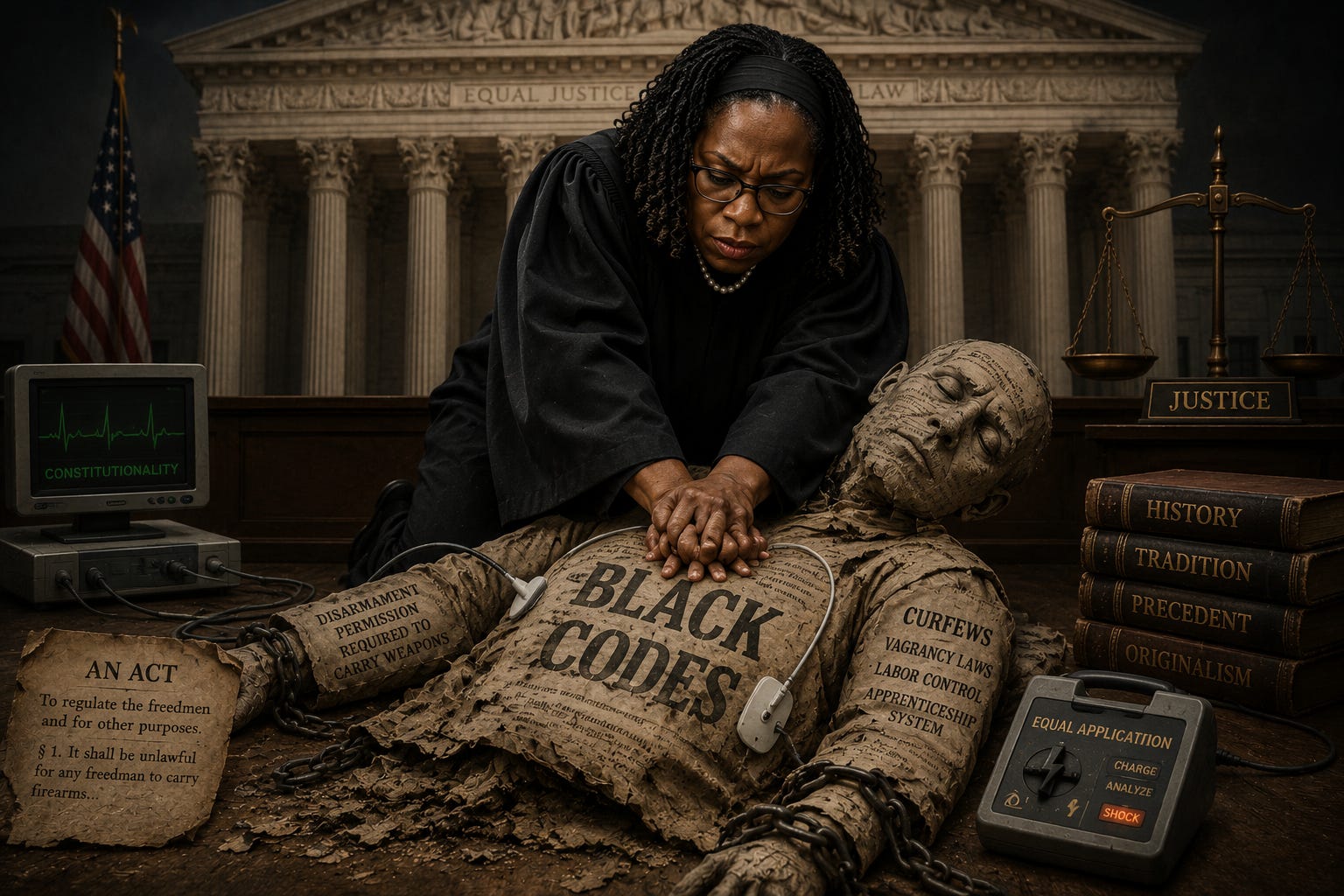
When I finished reading the Supreme Court’s recent decision in Wolford v. Lopez, I found myself thinking far less about the majority opinion than about Justice Ketanji Brown Jackson’s dissent. The majority decided an important Second Amendment case. The dissent, however, raised a constitutional question whose troubling implications extend well beyond firearms.
The case arose after Hawaii defended one of its gun control laws by relying, in part, on an 1865 Louisiana statute requiring permission before carrying a firearm onto another person’s property. Hawaii argued that its law, which generally required armed citizens to obtain a property owner’s consent before carrying a firearm onto private property open to the public, fit comfortably within the nation’s historical tradition because comparable restrictions had existed during Reconstruction.
The Supreme Court rejected that argument. Writing for the Court, Justice Samuel Alito explained that Louisiana’s law was not merely another nineteenth-century firearm regulation. It formed part of the notorious Black Codes enacted after the Civil War to disarm newly freed black Americans and leave them vulnerable to racist violence. Those laws were not evidence of the constitutional tradition secured by the Fourteenth Amendment; they were among the very abuses that Amendment was designed to eliminate.
Justice Amy Coney Barrett’s concurrence identified what I believe was an even deeper problem. The constitutional defect in the Black Codes could not be understood merely by reading their text. Those laws were enacted to preserve racial domination. A legal rule born to accomplish that purpose cannot become a reliable guide to constitutional meaning simply because it resembles a modern regulation.
However, Justice Jackson believed another question still remained. She did not defend the Black Codes. She condemned them without qualification. Her concern was methodological. If courts are required to determine constitutional meaning through historical analogies, judges need a principled explanation for deciding why some historical laws count while others do not. More specifically, she questioned whether at least some provisions associated with the Black Codes were unconstitutional because they discriminated against black Americans rather than because every legal rule they contained was itself constitutionally defective.
Thus, the modern gun control debate reached a truly remarkable point in Wolford. Hawaii asked the Supreme Court to treat a provision associated with the Black Codes as evidence of our constitutional tradition, while Justice Jackson proposed developing an interpretive strategy by which courts might eventually have to decide whether at least some provisions of the Black Codes survive once stripped of their racial classifications.
Of course, the Black Codes were not simply collections of offensive words waiting to be edited. They were legal expressions of a racist social and political order. They regulated black labor, movement, property, association, economic independence, and the possession of arms, all in an effort to preserve white supremacy after emancipation. Some provisions expressly discriminated on the basis of race. Others employed broader language. Yet they functioned together within a legal system designed to keep one class of citizens politically weak, economically dependent, and unable to defend themselves against white supremacist violence.
In her dissent, Jackson raised the possibility that a scheme of constitutional interpretation might separate legal rules from the repressive systems that gave them meaning. Yet it is one thing to distinguish a law’s text from its application and quite another to treat a legal rule as though it can be divorced from the racial regime and oppressive purposes that gave it constitutional significance simply because legislators eventually learned to codify domination in more general terms. Textual sanitation is not historical, constitutional, or moral purification.
Justice Jackson’s dissent ultimately raises a question that I suspect she never intended to ask. If courts conclude that at least some infamous rules embodied in the Black Codes remain constitutionally valid once stripped of their racial classifications and abstracted from the oppressive system that produced them, would any Americans—especially white Americans—actually be willing to live under those rules?
If the answer is no, then perhaps the constitutional problem with the Black Codes was never merely who they targeted. Perhaps some legal principles are so deeply bound to systems of inequality and domination that they cannot be redeemed through equal application.
The Black Codes are not a cautionary tale because they were applied unequally. They are a cautionary tale because they embodied a conception of the relationship between free citizens and government that no constitutional methodology should resurrect. The Black Codes are not for anyone, let alone everyone.