
Legislative Abdication and Death in Minneapolis

The bill for Congress’s refusal to govern has come due, and it is being paid not by politicians, but by people caught in the middle: immigrants, neighbors, protesters, and agents alike.
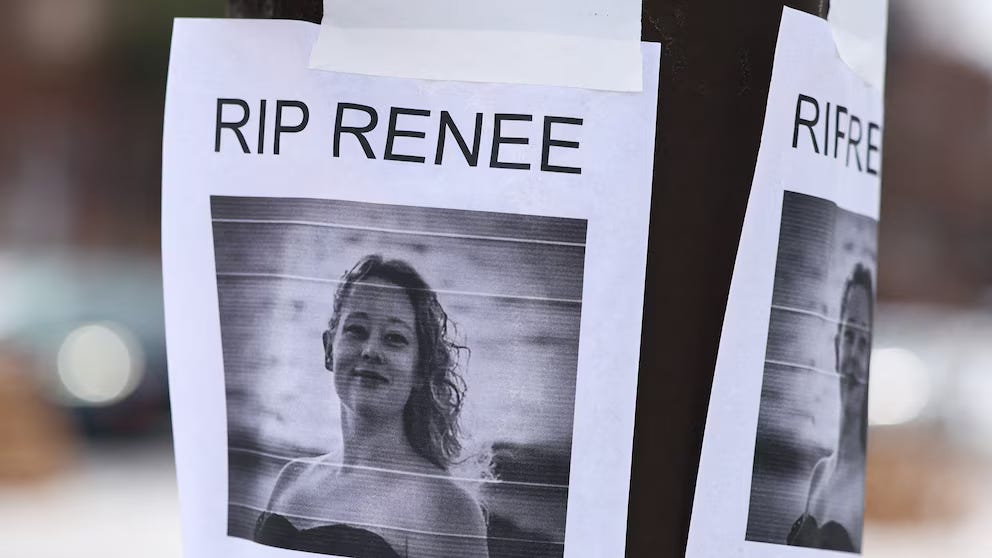
Congress didn’t fire the shots that killed Renee Nicole Good on January 7. But for decades, it has plausibly built and maintained an immigration vacuum in which encounters like this become more likely, more chaotic, and more combustible, then stepped aside as if plausibility carried no responsibility. To see how, start with what happened on a Minneapolis street and follow the trail back to Capitol Hill.
After viewing video evidence, federal officials quickly framed the ICE agent’s shooting of Good as self‑defense and cast Good as a violent threat, while the mayor of Minneapolis publicly rejected that account as “bullshit” and the governor demanded a full investigation. Protests followed, national coverage exploded, and another law‑enforcement encounter turned into a civic rupture rather than a contained legal process. Trust evaporated, and a single disputed shooting became a national referendum on legitimacy.
This piece will not adjudicate the shooting; that work belongs to investigators and courts. However, even if the agent’s actions are ultimately deemed lawful, the encounter was a foreseeable outcome of an immigration regime Congress has refused to modernize or govern coherently for decades. A system built on aging statutes, neglected courts, and political theater makes combustible street‑level clashes less an aberration than a risk budgeted into inaction.
What passes for American immigration law is a mangled mess of overlapping rules, shifting priorities, moral posturing, and sudden enforcement surges layered atop statutes from 1986 and 1996 that were never designed for today’s realities. Congress has repeatedly assembled bipartisan frameworks, most notably in the mid‑2000s and again in 2013, only to let them die without a vote or bury them in intra‑party warfare. The result is not legislative compromise but legislative abdication.
When Congress does not set clear, updated rules, the hard work is pushed downhill. Thus, presidents of both parties have toggled between mass-guidance memos and high‑visibility crackdowns, leaving agencies to redesign national policy through training bulletins and raid schedules. Immigration courts are chronically underfunded, backlogs stretch for years, and “limbo” becomes the core operating condition of the system. Policy is made less by statute than by successive bouts of executive improvisation and courtroom trench warfare.
As a result, federal agencies are told to act decisively without stable legislative guidance, to show “control” using tools the law has left blunt or outdated. Front‑line officers are sent into communities saturated with fear, anger, and cameras, instructed to enforce national priorities that often shift with election or news cycles rather than statutes. Everyone improvises, is expected to remain calm, and is told to accept the outcome when haste collides with fear and panic.
For millions of undocumented people, life means years of de facto tolerance interrupted by sudden crackdowns—rules that shift without warning and enforcement that appears more like political theater than law. They are tolerated when convenient and targeted when symbolic value is high. They become economically advantageous but legally provisional, indispensable to labor markets yet always one memo from being recast as a threat.
That combination destroys legitimacy. When people experience the law as erratic, episodic, and indifferent to consequences, they stop seeing it as binding in any moral sense. When legitimacy collapses, compliance follows, replaced not by chaos for its own sake but by organized resistance to what appears to be arbitrary power.
Supporters of maximal enforcement regularly insist that force restores order. It can, but only inside a system that is intelligible and bounded, even when strict. It fails when it looks arbitrary, punitive, and performative, appearing less like a routine civic function than a rolling demonstration of political will. At that point, every encounter becomes a test of wills rather than an application of rules. When that fractured system meets a volatile national crackdown, the odds rise that an ordinary traffic obstruction becomes a federal standoff and a disputed shooting becomes a national referendum.
By refusing to legislate clearly and humanely, Congress has turned immigration enforcement into a sequence of high‑risk encounters rather than a predictable administrative process. Undocumented people are left in permanent uncertainty, never sure whether today’s posture is tolerance, triage, or spectacle. Communities brace for disruption as a normal part of life, and agents operate in legitimacy‑starved conditions where every move is scrutinized and every error amplified.
The danger extends well beyond migrants themselves. Friends who give rides, neighbors who step into the street with a phone, and the agents themselves are all exposed when enforcement is staged as a spectacle in an atmosphere of distrust. Clergy who show up to pray and protesters who block traffic out of desperation find themselves swept into scenes where fear outruns judgment and nobody believes the rules are stable. A system that treats every operation as a test of loyalty eventually treats every bystander as a potential combatant.
The United States cannot indefinitely keep millions of undocumented immigrants in legal limbo and expect calm compliance. It cannot vacillate between tolerance and crackdown and call that good governance, nor demand quiet obedience from people who reasonably suspect their status is a bargaining chip rather than a settled legal question. It cannot be surprised when desperation meets authority on a crowded street and someone dies.
The Trump administration did not invent these risks, but it has sharpened them. Previous administrations toggled between leniency and restraint inside the same broken framework, but this one has chosen escalation as a governing style, and in a vacuum, escalation is gasoline. Aggressive raids and apocalyptic rhetoric may satisfy political appetites, but they corrode the cooperation that enforcement requires and inflame the distrust on which violence feeds.
Still, the deeper failure lies upstream. Congress created this mess, then hid behind it, preferring symbolic votes and press conferences to the grind of drafting law. If it continues to evade responsibility, the pattern will repeat: improvisation provoking backlash, backlash inviting escalation, escalation hardening fear, until another routine morning ends the same tragic way.
Minneapolis should not be remembered as an anomaly or a partisan Rorschach test. It should be remembered as the cost of legislative cowardice stretched over decades, a case study in what happens when lawmakers choose stalemate over structure and theatrics over sound and sagacious policy.
The bill for Congress’s refusal to govern has come due, and it is being paid not by politicians, but by people caught in the middle: immigrants, neighbors, protesters, and agents alike. That is not the rule of law. It is what remains when Congress confuses noise for leadership, performs outrage instead of legislating, and leaves the rest of the country to live with its own failure of nerve.