
Thomas Sowell on Photography, Knowledge, and Decisions

Economist Thomas Sowell drew on his knowledge of photography to illustrate how a free society can thrive despite widespread ignorance.
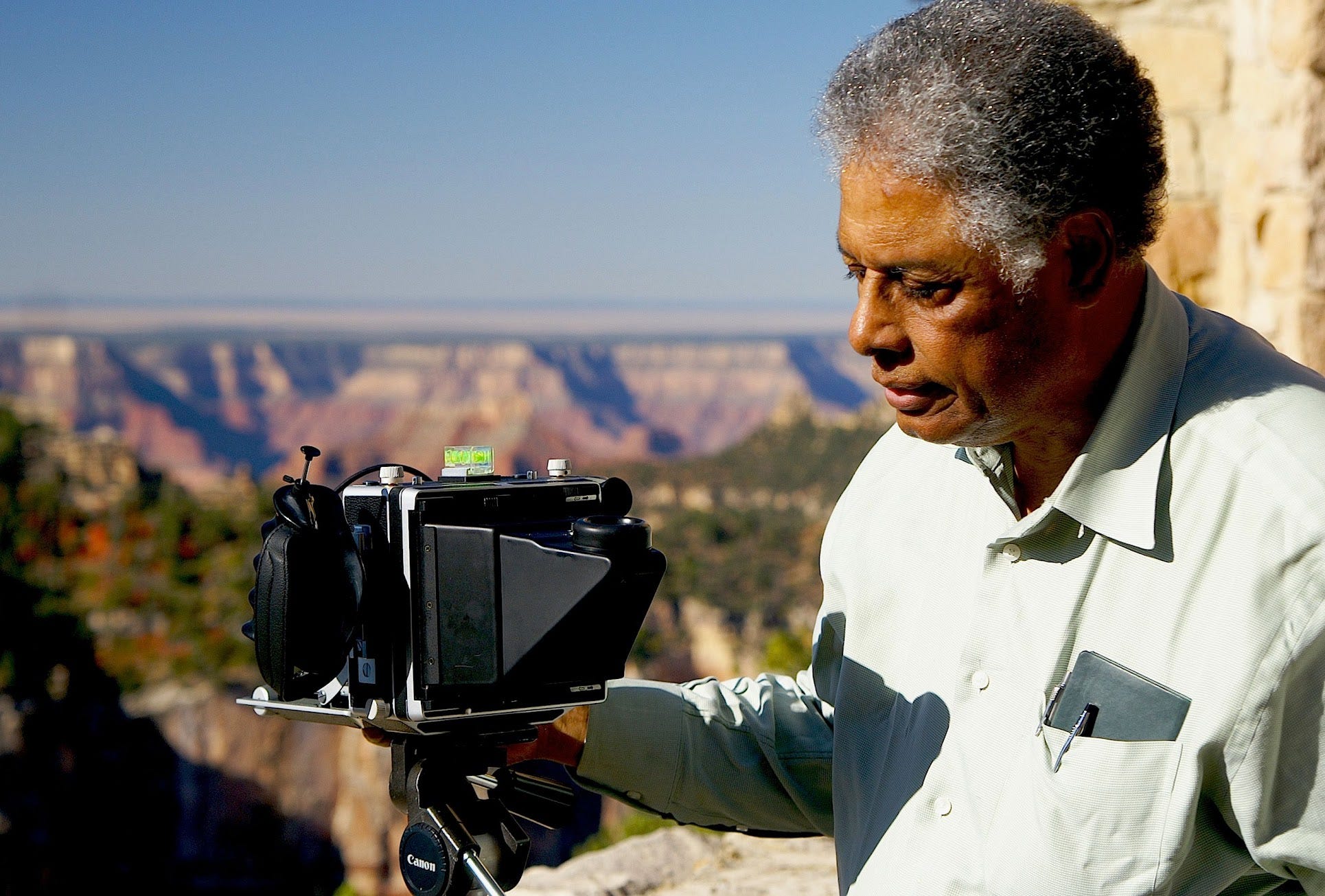
As a professional photographer with a deep interest in economics, politics, law, libertarian thought, and the life of the mind, I have always been drawn to Thomas Sowell’s research and reflections on these subjects. Especially fascinating is how he repeatedly invokes aspects of both analog and digital photography as he discusses broader questions about knowledge, pricing, competition, technological change, expertise, and freedom.
Most people know Sowell as a renowned economist, columnist, historian of ideas, and critic of intellectual fashions. Far fewer know that photography was woven through much of his life. During the Korean War era, he served in the Marine Corps Combat Camera Corps. Later, he maintained a lifelong interest in photography, publicly displayed some of his own photographs, and near the end of his syndicated column-writing career remarked that he hoped to spend more time taking pictures and less time following politics.
Photography also became a practical domain through which Sowell clarified how complex societies actually function. One of the clearest examples appears in Basic Economics, where Sowell discusses a professional photographer deciding whether to purchase a more expensive telephoto lens with greater light-gathering capability. His point is not aesthetic. It is epistemological.
The photographer does not need to understand every optical formula, manufacturing process, engineering compromise, or metallurgical detail involved in producing the lens. Prices themselves communicate information. The higher price reflects scarce engineering skill, production complexity, alternative uses for materials and labor, and countless technical decisions invisible to the buyer. The photographer’s task is simply to decide whether the added capability justifies the additional cost for the work he intends to do.
That example captures a recurring theme in Sowell’s work: modern civilization functions not because individuals possess complete knowledge, but because decentralized systems allow human beings to cooperate despite limited knowledge.
A camera lens is not merely glass inside a metal tube. It is the visible residue of countless invisible decisions involving optical science, manufacturing precision, engineering labor, transportation networks, inventory systems, market demand, and consumer judgment. The photographer standing at the counter deciding between two lenses may understand only a tiny fraction of the knowledge embedded inside the product. Yet somehow the system still allows him to make a rational decision.
That reality mattered enormously to Sowell.
In Knowledge and Decisions, he argued that modern life advances not because ordinary people become masters of every technical discipline, but because specialized knowledge becomes embedded within tools, institutions, and processes that ordinary people can use without fully understanding. Photography provided him with especially vivid illustrations of this process. Or, as he put it, “Science and technology lead to far more complexity in producing cameras and film today, but that growing complexity among a handful of technicians permits far more simplicity (and ignorance) in the actual use of modern photographic equipment and materials by a mass of people.”
For example, Matthew Brady’s Civil War-era photography required substantial technical knowledge of chemistry, plates, exposure, and development. However, modern cameras increasingly shifted that complexity away from the user and into the product itself. The simplification experienced by the consumer was not the disappearance of knowledge. It was the redistribution of knowledge. An amateur photographer could certainly learn shutter speeds, apertures, exposure calculations, and depth-of-field principles by studying photography books. But many consumers rationally chose not to acquire that expertise personally. Instead, they purchased the practical results of expertise already embedded inside something like the Kodak Instamatic camera.
In other words, ignorance is not always irrational. In advanced societies, people constantly rely upon systems that allow them to benefit from knowledge they do not personally possess. One need not design a lens, formulate photographic emulsions, engineer autofocus systems, or understand semiconductor physics in order to benefit from photography. Likewise, one need not master the countless technical processes underlying modern civilization in order to participate meaningfully in economic life.
Sowell also emphasized that this is hardly understood or appreciated by intellectuals and planners, who underestimate both the dispersion of knowledge and the impossibility of centralized mastery. Cameras themselves embody distributed intelligence. Inside even a modest camera resides the accumulated work of scientists, engineers, chemists, machinists, software developers, logistics systems, and competitive pressures spanning generations and continents. No planner fully possesses all that knowledge. No photographer fully possesses it either. Yet the system works.
Consider Sowell’s discussions of brands and reputation. In Basic Economics, he notes that someone highly knowledgeable about photography may safely purchase an off-brand or second-hand camera or lens, while someone less knowledgeable in another field may rationally rely on a familiar brand name instead. Brand names, in Sowell’s telling, are not merely advertising ornaments. They often function as substitutes for information that consumers do not possess directly.
Kodak and Fuji become examples of this principle. The issue is not simply whether one roll of film is marginally superior to another. The deeper point is that companies selling products under their own names have reputations at stake. If quality declines, they risk future losses. Reputation, therefore, becomes a form of market discipline.
Here again, photography serves as a practical illustration of broader economic realities. A box of film sitting on a shelf carries more than emulsion. It carries accumulated trust, prior experience, competitive pressure, and the threat of future consumer rejection.
That is why Sowell resisted the simplistic habit of treating markets merely as arenas of greed. Markets also discipline error. They expose complacency. They reward useful adaptation. They allow people to act on limited knowledge without requiring complete understanding.
Photography also provided Sowell with unusually vivid illustrations of technological disruption and the fragility of apparent dominance. Graflex once seemed to dominate the world of press cameras. The Speed Graphic became so ubiquitous in newspaper photography that it almost came to symbolize the profession itself. Yet advances in film, optics, and smaller 35mm systems eventually rendered those large press cameras increasingly obsolete. Graflex eventually disappeared.
Sowell repeatedly returned to this history because it illustrated something economists, regulators, and politicians often forget: market leadership is usually temporary. A company may appear dominant because it has solved yesterday’s problems exceptionally well. But markets are dynamic processes, not static conditions. The very strengths that produce success in one era may become burdens in another.
Kodak also became one of Sowell’s clearest illustrations of this reality. George Eastman helped democratize photography by dramatically lowering the technical barriers required to make pictures. Before Kodak, photography demanded substantial expertise involving plates, emulsions, development, printing, and cumbersome equipment. Kodak simplified the process and allowed ordinary people to document family life, travel, childhood, war, celebration, grief, and daily existence without professional training.
Sowell clearly appreciated the magnitude of that achievement. But he also repeatedly emphasized that past success does not guarantee future survival. In Discrimination and Disparities, Kodak figures into a broader argument about prerequisites. Success depends upon multiple conditions remaining aligned simultaneously. A company, institution, or civilization may possess nearly every quality necessary for success and still fail once one critical prerequisite changes.
Kodak possessed technical expertise, manufacturing capacity, brand recognition, global reach, and deep roots in photographic culture. Yet when digital imaging transformed photography, the old ensemble of advantages no longer guaranteed continued dominance because the terrain itself had changed.
Indeed, this is where Sowell’s discussion becomes explicitly Schumpeterian. The decisive competition was not merely Kodak versus Fuji. The more serious threat of “creative destruction” came from technological substitution itself as digital photography changed the very structure of the market. The point is that the most consequential competition often comes not from rivals making slightly better versions of existing products, but from entirely new technologies and methods that redefine the landscape altogether. The company that appears to “control” a market may be far less secure than it looks because the most dangerous rival may not yet resemble a rival at all.
It is a lesson that extends far beyond cameras.
In his essay “Photography and the Economy”, Sowell begins with a practical irritation familiar to film photographers of a certain generation: in many countries, Kodachrome film could be purchased with processing included, while antitrust policies in the United States prevented Kodak from selling it that way domestically. Sowell regarded this not as consumer protection but as an example of regulators misunderstanding competition itself.
Kodak already faced substantial international competition from Fuji, Agfa, Ilford, and others. Consumers were not helpless captives. Competition—not bureaucratic restriction—was what disciplined producers and protected buyers. To the contrary, antitrust thinking often relied upon static conceptions of market power. Regulators and intellectuals would observe a large market share and speak as though permanent “control” existed, but photography repeatedly demonstrated how fragile such dominance could be.
Photography provided Sowell with a powerful way to illustrate the danger of mistaking a snapshot for a process. The same essay also contrasts competitive markets with Soviet stagnation. Sowell describes the Soviet Union continuing to manufacture an outdated camera based on a 1936 German model using captured World War II dies. His point was not merely that the camera was old. It was that protected systems without meaningful competition often experience little pressure to improve.
Meanwhile, in international markets, camera manufacturers continually innovated because failure carried consequences. Indeed, this theme appears repeatedly throughout Sowell’s work. Systems matter. Incentives matter. Feedback matters. Good intentions alone do not guarantee adaptation or competence.
Photography also became a revealing arena through which Sowell explored informational paternalism and elite gatekeeping. Thus, one of the most fascinating examples appears in his verified 1983 letter to Popular Photography magazine. The magazine had begun concealing the names of cameras used to create published photographs. Presumably, the editors hoped to prevent readers from making superficial assumptions based upon expensive or prestigious equipment.
Sowell objected. Not because he merely wanted technical trivia, but because he recognized the paternalistic impulse beneath the policy. He recalled enjoying knowing which photographs had been taken with which cameras. Sometimes the information surprised him. Sometimes impressive images came from modest equipment. Sometimes expensive cameras produced less impressive work than readers might have expected. The information expanded judgment rather than imprisoning it.
Then came the line that transformed the letter to the editor into something larger than a hobbyist complaint: “Whenever we start deciding what other people can be allowed to think about, we are skating on thin ice. Next year is, after all, 1984.”
The point was not simply about camera captions. It was about gatekeepers deciding what information ordinary adults were mature enough to handle.
That concern fits naturally within Sowell’s broader skepticism toward the concentrated authority of political busybodies. Throughout his work, he repeatedly warned against the presumption that intellectuals, planners, bureaucrats, journalists, judges, or experts can safely substitute their filtered judgment for the decentralized judgments of millions of ordinary people.
Admittedly, concealing the camera used to take a photograph may appear trivial. But small acts often reveal larger habits of mind. The editor who withholds information for the reader’s own good belongs, in miniature, to the same family of thought as the planner who mistrusts consumer choice or the expert who believes the public must be shielded from dangerous conclusions. The scale differs. The impulse is recognizable.
Sowell’s reflections on stereotypes and markets could also be elucidated through photographic experience. Recalling his Marine Corps photography days, he described how the behavior of earlier graduates from the Pensacola photography school caused a superior officer to reject a later graduate sight unseen. Sowell’s point was not to celebrate unfairness. It was to force readers to confront the costliness of individualized knowledge.
In the real world, information is limited, time is scarce, and people rely upon probabilities, patterns, reputations, and prior experience. The important question, for Sowell, was not whether human beings generalize. The question was what institutional arrangements impose costs on false generalizations.
Consistently, his answer often pointed toward markets. Businesses that irrationally reject capable workers, customers, technologies, or opportunities impose costs upon themselves. Markets do not eliminate error, prejudice, or ignorance, but they discipline them more effectively than insulated political systems do.
This is not a sentimental view of markets. It is a disciplined view of human limitation. Sowell never assumed that markets make people virtuous. He assumed nearly the opposite: human beings are partial, self-interested, limited, and often wrong. The question is what systems most effectively force correction. Inferior products lose reputation. Outdated firms collapse. Technologies become obsolete. Consumer preferences shift. Static theories fail to anticipate dynamic change. And centralized authorities often misunderstand systems too complex for any one mind to fully grasp.
Of course, none of this means photography secretly explains Thomas Sowell. That would almost certainly be too neat for Sowell himself. But the recurring pattern remains analytically meaningful. Photography repeatedly became a particularly fertile operational domain through which Sowell clarified larger truths about prices, knowledge, reputation, technological change, institutional arrogance, competition, and freedom. That alone is a substantial insight, yet perhaps there is a broader lesson for the rest of us.
We live in an age increasingly tempted by informational guardianship. More and more institutions claim authority to curate reality on behalf of the public. Citizens are told they must be protected from misinformation, harmful comparisons, dangerous conclusions, excessive complexity, or the anxieties of too much freedom.
Sowell’s recurring discussions of photography remind us that framing is never neutral. Someone decides what remains visible. Someone decides what remains outside the frame. Someone decides which comparisons may be made, which contextual details matter, which tradeoffs may be acknowledged, and which conclusions are considered permissible.
That is why the connection between photography, economics, and freedom is not merely metaphorical. Photography repeatedly provided Sowell with a practical way to illuminate how free societies actually function through dispersed knowledge, decentralized judgment, competition, adaptation, correction, and the freedom of ordinary people to encounter reality without permanent mediation by self-appointed custodians of interpretation. And, as it turns out, photography often helped him show this clearly.
You're on a roll, amigo. Another splendid essay. I recall how Tom took his camera everywhere. He even took pictures of me when I was giving a seminar at the Hoover Institution in the 1980s, which was hardly a normal experience for me. Another terrific economist-photographer was my old colleague Steve Cheung at the University of Washington in the 1970s.